Outcast Status
Jonathan Livingston SeagullOutcast Status is the Flock’s formal banishment of gulls who violate its traditions, a punishment that turns a community boundary into both a social sentence and, in Jonathan Livingston Seagull’s story, an unintended opening toward freedom. It removes the condemned gull from shared life, yet cannot extinguish the desire to learn: Jonathan’s solitary exile becomes the ground on which he develops his flight, while later students risk the same status to follow him back to the Flock’s beach.
Definition and First Imposition
For most gulls, flight is a means of getting from shore to food and back; Jonathan instead makes flight itself his purpose. His experiments already set him apart from ordinary expectations: he spends whole days alone gliding low over the water, discovers that a close, streamlined glide keeps him aloft with less effort, and practices feet-up landings that dismay his parents. In a culture where stalling is treated as disgrace, his practice makes visible the conflict between inherited standards and the pursuit of a different kind of life.
The decisive punishment comes when the Council condemns Jonathan for reckless irresponsibility and for violating the dignity and tradition of the Gull Family. To be centered for shame means expulsion from gull society and banishment to a solitary life on the Far Cliffs. The charge is not simply that he has made a flying error: the Council frames his search for a higher purpose as a rejection of the community’s account of what life is for, insisting that gulls are in the world to eat and stay alive.
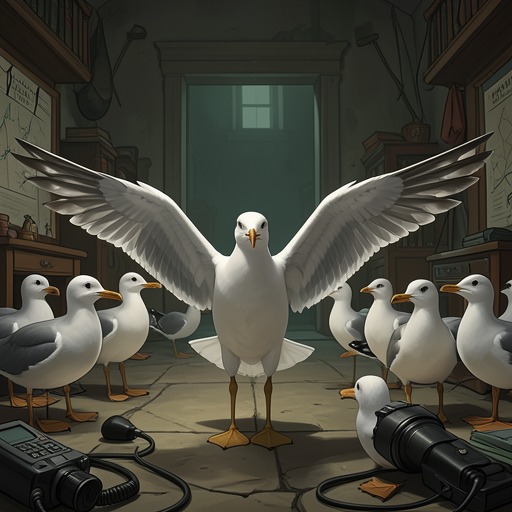
Jonathan answers that he is acting responsibly by following meaning, learning, discovery, and freedom. The Flock does not engage his appeal. Its members declare the Brotherhood broken, close their ears, and turn their backs in unison. The ritual makes exclusion collective and visible: the punishment is not only a sentence pronounced by authority but a refusal of relationship enacted by the flock itself.
Life Beyond the Far Cliffs
Jonathan spends the rest of his days alone, but solitude is not the deepest cost. His sorrow is that other gulls will not believe in the glory of flight or open their eyes to it. The distinction matters: exile deprives him of companionship, yet his grief centers on the knowledge and possibility the community refuses. He does not regret the price he has paid for learning to fly.
Beyond the Far Cliffs, he keeps learning. A streamlined high-speed dive lets him catch rare, tasty fish schooling ten feet below the ocean’s surface, freeing him from dependence on fishing boats and stale bread. He learns to sleep in flight, traveling a hundred miles from sunset to sunrise, and to fly through sea fog before climbing into clear sky while other gulls remain grounded. He also rides high winds inland to feed on delicate insects. Exclusion has taken away ordinary membership, but it has not confined his movement or capacity to discover new ways of living.
The narration links his extended life to a change in thought: Jonathan discovers that boredom, fear, and anger shorten a gull’s life, and that as these leave his mind, he lives a long, fine life. His exile therefore has a double consequence. It is a real social loss, imposed by a community that will not listen, but it also gives him the space to pursue the practice the community condemned and to find forms of flight and survival unavailable to him before.
A Boundary Carried into a New World
Jonathan’s status as an Outcast does not define his identity forever. In the new world, when his teachers tell him that one school is finished and another is beginning, understanding brings him to recognize that he can fly higher and that it is time to go home. The movement back is significant because his return begins from the position that once seemed to leave him with no home and no Flock. Exclusion has not erased his connection to the gulls he left behind; it has changed what he can offer them.
After Chiang’s departure, Jonathan thinks repeatedly of Earth and wonders whether a gull there might be struggling to break beyond its limits, or might have been made an Outcast for speaking truth to the Flock. As he practices kindness and seeks to understand love, his desire to return grows. He sees teaching as a way of giving another gull the chance to see truth for itself. On leaving, he understands himself not as bone and feather but as an idea of freedom and flight, limited by nothing. The journey reframes exile: it is not a final severance but part of the experience that equips him to teach.
The Rule Repeats Around His Students
On Earth, the old law remains explicit and severe: an Outcast never returns, and the law has not been broken in ten thousand years. When Jonathan turns toward the Flock’s home grounds, his students hesitate because they are not welcome. The law says to stay away; Jonathan says they are free to go where they wish and be what they are. He continues across the water toward a potentially hostile Flock, forcing the students to choose whether the rule still binds them.
Fletcher Lynd Seagull, himself still young and newly condemned, knows the experience as an injustice. His anger comes from the disproportion between the small act that triggered his punishment—a barrel-roll around the Elder Gull for fun—and the larger possibility of flying that the Flock refuses to see. He resolves to show what flying can be, even if that means becoming a complete outlaw. His experience echoes Jonathan’s: in both cases, the Flock treats flight beyond ordinary travel as grounds for rejection.
A month after Jonathan’s return, the law is applied again to someone who asks to learn. Terrence Lowell Gull becomes a condemned bird, labeled Outcast, when he crosses the line and asks Jonathan for instruction; he becomes the eighth of Jonathan’s students. The episode makes the cost of learning concrete: approaching the teacher is enough to transfer the stigma of exclusion from the original exile to a new seeker.
Exclusion, Visibility, and Change
The students’ return exposes a contradiction in the Flock’s response. Their flight across Council Beach at a hundred thirty-five miles per hour, in a close double-diamond formation that rolls together, makes the supposedly impossible return unmistakable. Younger gulls are startled not only that Outcasts have come back but that they can fly with such skill. The Flock’s first response is not welcome or open engagement. The Elder’s word takes almost an hour to pass through the community: ignore the newcomers; speaking to an Outcast makes a gull an Outcast, and even looking at one breaks the Law of the Flock.
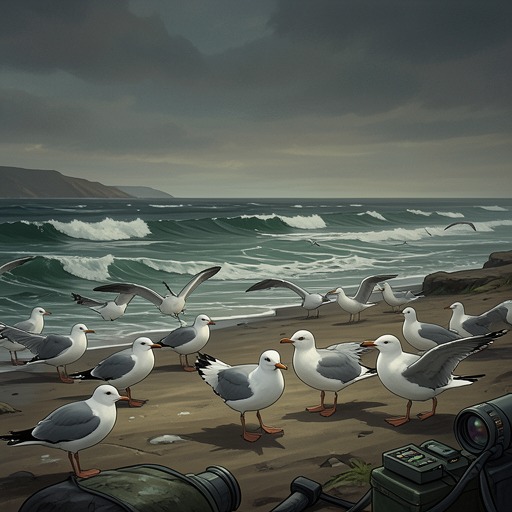
The enforcement is both social and perceptual. Gray-feathered backs turn away, while Jonathan proceeds with practice sessions directly over Council Beach, apparently undeterred. A circle of curious gulls forms around his students at night; they listen for hours in darkness, wary of being seen, and disappear before daybreak. The law can command public avoidance, but the covert audience suggests that curiosity and the wish to learn survive beneath that performance of obedience.
Outcast Status thus changes meaning across the story without losing its force. At first it is the consequence of Jonathan’s refusal to let the Flock’s narrow definition of life govern his pursuit. Later it becomes a danger inherited by those who learn from him, and the old prohibition confronts a returned group whose abilities make the boundary harder to sustain. Banishment can sever a gull from communal recognition, but it cannot prove the condemned gull wrong, prevent others from seeking instruction, or permanently keep the excluded beyond the community’s sight.